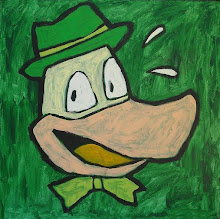
After recently learning that the great old ice cream stand Cree-Mee has bitten the dust, I started worrying about my favorite retro snack stand of them all, The Twin, which we discussed just last week. So, I trekked out to Irvine and was relieved to see that it's still among the living, and that their cones are as uniquely delicious as they ever were. As you can sort-of see in the above image, their cones are a custardy, vanilla-beany, off-white color.
Tuesday, June 10, 2008
The Twin Still Going Strong
After recently learning that the great old ice cream stand Cree-Mee has bitten the dust, I started worrying about my favorite retro snack stand of them all, The Twin, which we discussed just last week. So, I trekked out to Irvine and was relieved to see that it's still among the living, and that their cones are as uniquely delicious as they ever were. As you can sort-of see in the above image, their cones are a custardy, vanilla-beany, off-white color.

Monday, June 9, 2008

Taylorsville Road
 Better known as Highway 155, this road starts out well-traveled in the bustling Highlands of Louisville, then takes you out to Hikes Point and Jeffersontown before you find yourself out of the middle of glorious nowhere. If you follow it long enough you’ll end up in - you guessed it - Taylorsville.
 Nearby Taylorsville Lake is a popular fishing destination and has the added bonus of being nestled in a particularly eerie wooded part of the state. Other points of interest along the way include:
The Pigg House of Berea


In 2003, on our original Unusual Kentucky site, we complained about how the Pigg House, a wonderful old historic log cabin, was being neglected by Berea College, and was becoming a haven for unsupervised kids messing around in it. We wrote:
This ancient log cabin (tucked away deep in the wilderness outside Berea) is supposedly being kept and preserved by Berea College, but the place is dilapidated and rundown, and evidently a popular spot for local idiot kids to come and party, leaving trash and graffiti everywhere. Some of these kids were stupid enough to write their full names on the walls, along with the date they were there.
Did anyone listen? Nope. Three years later, the place burned to the ground. Here's a squib from the Winter 2006 issue of Berea College Magazine:

Sunday, June 8, 2008
Buccaneer Drive-In
 Once this was a proud drive-in theater on U.S. 25 bringing customers from surrounding counties. I saw many first-run films here in the 1960s and 1970s, including The Blob, Westworld, Death Race 2000, Vanishing Point, Bonnie & Clyde, Equinox, When Dinosaurs Ruled The Earth, Frogs, Jaws, etc.
  The Buccaneer has been deserted for many years, and was originally on our old site's "Abandoned Places" section. Only a few weeks after we added it to our site, bulldozers appeared and began demolishing the place. Last we saw, the property was being used for storage of timber for some sort of commercial logging company.
 Madison County's other drive-in, Richmond Drive-In, is also gone, having mutated into Krazy Karts, which is itself now also defunct.
Richmond Drive-In / Krazy Karts
 This was Richmond Drive-In in the 1950s, 60s and 70s, then it went out of business.
 After an idle period it was purchased and transformed into Krazy Karts, a rather lame go-kart track and miniature golf course. Krazy Karts lasted at least until 1997, which was the last time I was there. Not sure when it lapsed into disuse, or when the place got wiped out by a fire, but when we got there to take some pictures awhile back, we discovered that all that remained is the sign out front and the charred rubble and remnants of what was once Richmond Drive-In's snack bar.
Let's just be real quiet for a few minutes.

Saturday, June 7, 2008
Sweet Evening Breeze
 Lexington is known for its unique eccentrics and characters, but none can surpass the notoriety and fame of "Sweet Evening Breeze", who managed to live openly as an African-American gay crossdressing male in the early-mid twentieth century.
 At a time in history when the idea of being "out" was nearly unthinkable, and when most who chose crossdressing not just as a hobby but as a lifestyle had to keep it on the DL, Sweet Evening Breeze would have none of that. Instead of sneaking and slinking around, she walked brazenly down the city streets of Lexington in broad daylight. Everyone in town knew "Miss Sweets" and loved her.
And somehow, despite the rampant bigotry of the times , it worked. Sweets, thanks to her evident powerful charisma and charm, gained a huge and curious following of friends, fan, and admirers. She had friends from all walks of life, from well-to-do fellow members of the Pleasant Green Baptist Church, to more bohemian pals and acquaintances met in restrooms of the Phoenix Hotel for "Tearoom Trade".
As with many cities in those days, Lexington had a law on the books forbidding crossdressing. There’s a story often told that when Sweets and another young black drag queen were thrown in jail, they entertained the sympathetic guards with the same routines they performed in drag clubs, and ultimately swayed the judge with Sweets’ persuasive argument that the crossdressing law was unconstitutional.
Sweet Evening Breeze died on Friday, Dec. 16, 1983, at the Homestead Nursing Center. He was thought to be in his 90s and was survived by many loving friends and family. For his achievement of being himself against the odds, the Royal Sovereign Imperial Court of All Kentucky named its highest honor the James Herndon Award. Last year the Lexington Men's Chorus also named its small singing ensemble Sweet Evening Breeze in his honor as well.
Sweets' grave, bearing her birth name James Herndon, can be found in the Lexington Cemetery.
Larry Flynt
 Kentuckian Larry Flynt, publisher of Hustler magazine, lays claim to being the world’s most famous pornographer, a title that not everyone would aspire to but one that he seems happy with. (His closest rival, Hugh Hefner’s Playboy magazine, is technically not pornography in the strict legal sense. Not to mention it’s boring.)
 Flynt was born and raised in Salyersville, KY, population 1,604. (Saaaaaa-lute!) He attended public school there but dropped out at some point, due to problems at home between his bickering parents. Flynt began his enterprising ways at a very early age, bootlegging moonshine in the Magoffin County wilderness.
At the age of 15, Flynt did a stint in the Army and then the Navy. In 1970 he opened a strip club in Cincinnati called the “Hustler Club” and soon followed it up with its own magazine that was an instant hit with its envelope-pushing editorial style. Today the franchise includes a casino and a successful chain of clean, attractive Hustler shops intended to offer a classier alternative to the usual sleazy porn stores.
Flynt’s lasting contribution to society may not be so much for his erotica, however, but for his involvement in legal precedents. The entire legal definition of what constitutes “pornography” was shaped largely because of his pushing the limits of what could be gotten away with during the 70s and 80s. (These definitions, however, have since largely been made irrelevant by the internet.)
In 1976, Flynt fought anti-porn campaigner Charles H. Keating Jr. all the way to the United States Supreme Court on charges of obscenity and organized crime, and beat them. Keating went on to later fame as a convicted felon in the notorious 1989 savings and loan fraud scandal.
In 1983, Flynt refused to reveal his sources for a John DeLorean tape recording that was very embarrassing to the FBI, and showed up in court wearing an American flag as a diaper. For this act of “flag desecration,” he was imprisoned six months.
Also in 1983, Flynt lost a Supreme Court battle over insulting remarks made about rival publisher Kathy Keeton. The case, however, is frequently cited as an example in law school courses today, because of its implications regarding personal jurisdiction over a defendant. Flynt harangued the court with a slew of insults and obscenities and was arrested for contempt of court (the charges were ultimately dismissed).

In 1988, Flynt successfully fought off a libel suit from the Reverend Jerry Falwell, over a satirical advertisement that suggested Falwell had sex with his mother in an outhouse. The Supreme Court sided with Flynt, eight to zero. The Falwell case decision cemented and affirmed the media’s right to satirically poke fun at celebrities in even the most brutal and cruel way.
Two other anti-porn activists, Peggy Ault and Dorchen Leidholdt, tried libel suits of their own after being named in Flynt’s “Asshole of the Month” column in Hustler. Both were dismissed with findings in favor of Hustler.
For most of his career, Flynt has faced legal challenges from the city of Cincinnati, a place which has often had a reputation for being a difficult place to exercise free speech (some constitutional activists have referred to it as "Censornati"). The city reportedly redrew zoning lines to deliberately make Flynt’s Cincinnati bookstore illegal, and sent an underage person in to purchase items there in a sting operation. He faced 26 years in prison but got off with a plea bargain.
Flynt is paralyzed from the waist down after an assassination attempt by White Supremacist Joseph Paul Franklin in Georgia (who claims to have been motivated to kill Flynt because of interracial sex being portrayed in his magazine). He makes an unlikely but effective warrior for First Amendment rights, and will probably be best remembered in this respect, especially after his portrayal by Woody Harrelson in the film The People vs. Larry Flynt.
Henry Faulkner
 Henry Faulkner was an eccentric crossdressing painter and poet, who considered his homeplace to be both from Simpson County and from the more exotic-sounding Egypt, KY (a very small town in Jackson County). He moved to Lexington in 1955, where he lived on Prall Street for a time with fellow crossdresser Sweet Evening Breeze before getting his own place at 462 West Third Street, in which he kept a small chicken farm in the back yard.
 (Henry's home, incidentally, was directly across from the street from the haunted Hampton Court.)
Throughout his life, Henry seemed destined to be connected to celebrities. He was a cousin of the writer William Faulkner. He was one of Tennesee Williams' lovers. He was incarcerated in a mental ward with Ezra Pound, whom he befriended. Though living in relative obscurity, his art was sought after by many serious art collectors and celebrities, such as Bette Davis, Marlon Brando, Nat King Cole, Phyllis George and Vincent Price. Socialite Anita Madden, famous for her wild Derby parties, was a friend of Faulkner’s.
He loved cats, chickens and goats, of which he had many, much to the consternation of some of his neighbors. One of his favorite pets was a goat named Alice who loved to drink bourbon. Alice even accompanied Faulkner to a court appearance once. His favorite watering hole was within walking distance, a place called The Fish Net at the corner of 2nd and Jefferson, where the Wingspan Gallery currently occupies.
Faulkner’s behavior may have seemed bizarre to many, but he lived life to the fullest without the shackles of social convention. Never losing his awe of nature, he often expressed himself in paintings of flora and fauna. By the early 1960s he was earning a living with his art.
Legends about Faulkner abound – and some may be truthier than others. Some say he had a habit of stiffing restaurants by grazing at salad bars and neglecting the check. Another story is told about Faulkner abruptly imploring the driver of a car he was in to pull over, so that he could jump out, strip naked, and frolic in a field of flowers in broad daylight for a long while before finally returning to the car as if nothing unusual had happened.
He was often seen riding his bicycle in drag down Third Street, or reading poetry and singing old blues ballads in bars. Extremely sensitive to beauty, Faulkner was at times given to convulsions while viewing a painting.
Faulkner died in an auto accident at The cursed corner of Third & Broadway on December 3, 1981, at 9:05pm.
(Image of Henry (with two friends in the service) courtesy of Bob Morgan by way of J.Todd Dockery.)
Friday, June 6, 2008
Lexington Cemetery Mausoleum
 We've heard plenty of anecdotal stories about the mausoleum at Lexington Cemetery being severely haunted, with disembodied voices, noises, and even screams being heard here. Another story tells of a "mysterious shadow" that is seen moving around at the rear of the building. Another report states that the place has an overpowering feeling of anger radiating from it.
 Not sure if anger is exactly the vibe I get from it, but there definitely is some sort of uncomfortable feeling I sense radiating from this place, and not just because it's a mausoleum. I get a somewhat suffocated and claustrophobic feeling inside here, even though it's very open and spacious. Of course, the suffocated feeling could derive from the fact that the place smelled awful the last time I was there. It was like they'd tried to cover something foul with aggresive amounts of Ozium, or that stuff that's supposed to give your car that "new car smell" again.

Return of the Living Dead
 Many people are unaware that the 1985 horror film The Return of the Living Dead's plot is set in Louisville, Kentucky, and in fact, was filmed on location there. Many Louisville streets and sights can be recognized from close scrutiny of the film.
 Interestingly, the film's introduction makes the claim that the movie is based on actual events - which might be news to the citizens of Louisville!
High Rock Petroglyphs
 Located in Nada, KY in Powell County, the High Rock petroglyphs are one of several mysterious rock carvings indigenous to the area. They're said to be made by very early Native Americans, though there are other theories about people from other lands having traveled through this region, as well as the legends of the ancient civilizations that dwelled in Kentucky even before the tribes we call Native Americans.
Pictured here is a piece of the High Rock petroglyphs, currently on display at the Red River Museum in Clay City.
Subscribe to:
Posts (Atom)