Showing posts with label tree. Show all posts

Monday, May 30, 2011

Nature's Morphology


Sometimes, strolling through Kentucky's wilderness, I'm struck by the imagery in ordinary nature scenes that can restimulate reactions in the mind. Psychologists call it pareidolia but I think there's something more to it than that. Jung was trying to understand it. Rupert Sheldrake came closer. Maybe The Wizard of Oz got it. Lost definitely did.


Saturday, May 14, 2011

Tree Buds with Mystery Fluff

One from my Visual Slushpile photo blog:


This mega-close-up shot of tiny buds on a tree branch (they're each smaller than a pea) revealed an even tinier white speck hanging in the air between them. One can just barely discern that it's clinging on one of two almost-invisible strands of web.

Is it a spider egg sac? Or an actual bit of fluffy detritus that floated along and got caught in a web?


My best guess is that it's a young specimen of those weird white insects that look like super-tiny bits of fluff even as adults. I tried a brief stab at googling and didn't see any immediate answers. Apparently a lot of people are in the same boat as me; they've seen it before but can't identify it.

Monday, March 7, 2011

Kentucky Coffeetree


Some of you may think of the coffeehouse in Frankfort when you hear the name, but the Kentucky Coffeetree was briefly our state tree, from 1976 to 1994.

It had originally been the Tulip Poplar, but in 1976 it was discovered that this had never officially been made legal in the Kentucky statutes. Rather than simply make a quiet adjustment to the statutes, the lawmakers felt the thing to do was to totally reopen the issue all over again. Louisville Courier-Journal writer Joe Creason campaigned hard to have the Kentucky Coffeetree appointed our new state tree, and soon he had the masses riled up behind him supporting this change. (Ironically, some say that Creason had originally intended his campaign as a joke, but when the public rallied behind it, he went along with it.)

Early European frontiersmen exploring Kentucky, having run out of coffee, would resort to roasting and grinding the beans of this tree as a (very poor) substitute for their java jones. George Washington was fond of the tree, and mentioned it in his writings. George Rogers Clark gave seeds to Thomas Jefferson, and the resultant trees can still be found on the lawn of Jefferson's Monticello today.

There are only two other species in the genus Gymnocladus, both of which are native to China, which makes me wonder - how came it to these shores? (The idea that Chinese explorers made it to North America long before Columbus is one that's gaining currency.)


This helpful site shows you in copious detail what the Kentucky Coffeetree and its seed pods look like. I can't condone anyone actually trying to make coffee from these seeds, because it just isn't safe. Like Cashews, the seeds are poisonous in their regular state and must be baked or roasted for at least three hours at 300 degrees.

Regarding its distribution, Wikipedia says: "Widely dispersed, but rare. The Kentucky Coffeetree, Gymnocladus dioicus, is considered a rare tree species. "Rare species are those that are so uncommon that they should be monitored to determine whether their populations are becoming threatened". Meanwhile, the Arbor Day Foundation says: "Resistant to disease and able to adapt to a wide variety of soils and climates, the Kentucky Coffeetree is an excellent choice for parks and golf courses. It is also widely used as an ornamental and street tree". Which begs the question, how has it become borderline-endangered if it's so hardy and easily adaptable?

Thursday, February 24, 2011

Trees of Life


I don't give a fig for much modern TV programming now that LOST is off the air, but I do adore that History Channel show Life After People. They use a mix of CGI and real footage to demonstrate just how quickly all traces of our civilization would be absorbed back into nature and disappear, if all humans suddenly just up and vanished. (Hope springs eternal.)

I always enjoyed the weeds that start to take back parking lots when the blacktop starts to crack and decay, like behind the abandoned Showcase Cinemas at Bashford Manor. If left untouched for another 50-100 years, the vast expanse of concrete would once again be a wildlife area - the back-and-forth temperature extremes of scorching summers and ice-encased winters will gradually weaken anything, be it concrete, steel, what have you. And the gentle forces of vegetation pressing upwards against the pavement shouldn't be underestimated - like slow water torture, each Spring brings pressure from below. Sooner or later it all begins to add up until shoots of plants with a lust for life succeed in breaking on through to the other side.


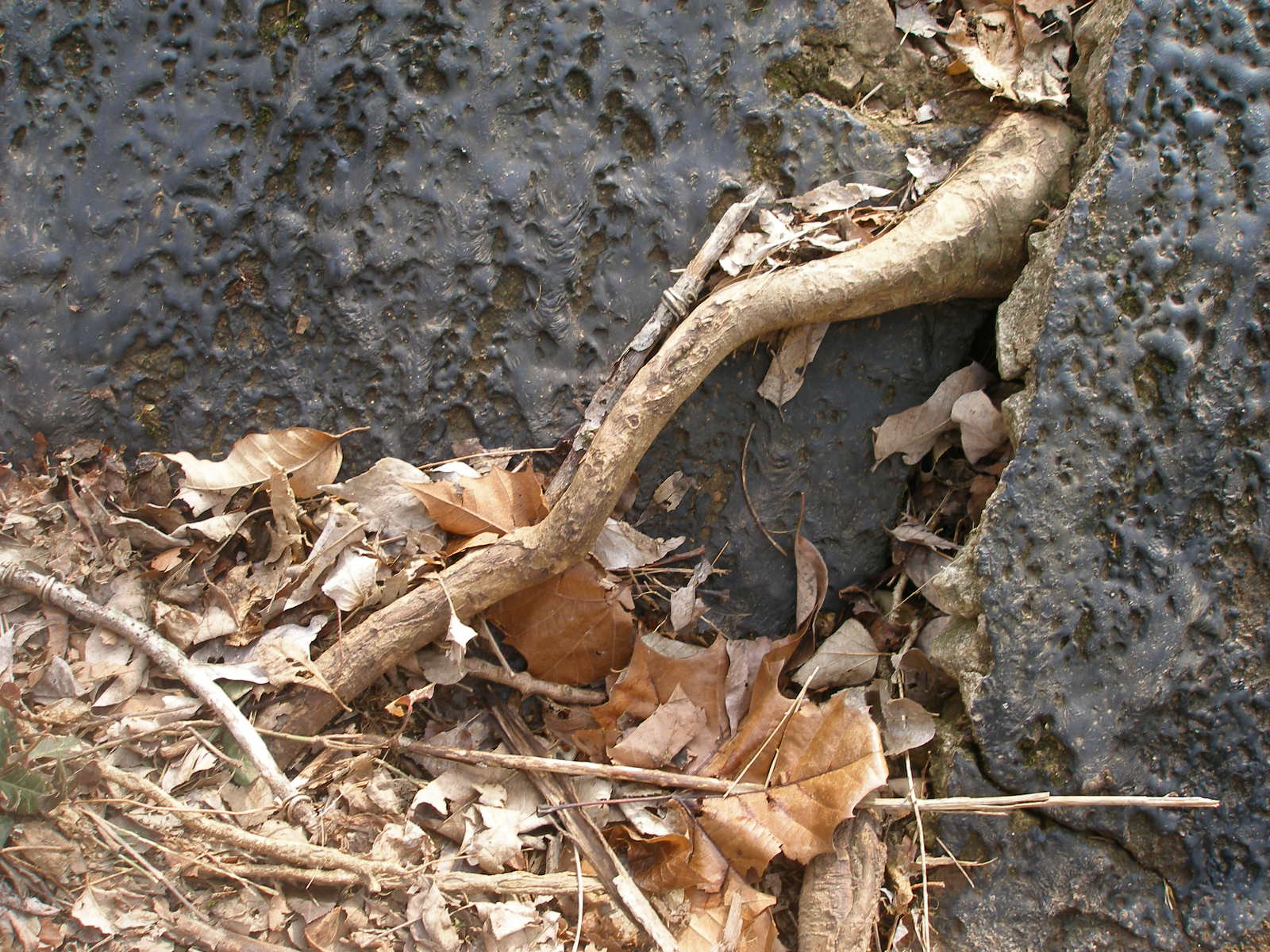
Now here's an even better example of nature's indomitable drive to survive. I spotted this pair of strong-willed trees in Anchorage refusing to let a thick slab of poured concrete stop their advance. And upon closer inspection, I could see their roots extending like tentacles some feet away, going over, under, around, whatever it needed to in order to get the job done.


If I had but ten people in my employ with half the determination, life force, and joie de vivre of these trees, imagine what could be accomplished overnight.

Wednesday, February 16, 2011

An American Chestnut in Adair


The American Chestnut, or Castanea dentata, once ruled the Appalachians with a range extending from Maine to Mississippi. They were extremely important to wildlife, providing much of the fall mast for species such as White-tailed Deer, Black Bears, Wild Turkey and, before it went extinct, the Passenger Pigeon. And now the American Chestnut is close to extinction itself.

Sometime in the late 19th century, the chestnut blight (Cryphonectria parasitica) was accidentally introduced into our country by imported chestnut trees or cheap imported Chinese lumber. The Chinese and Japanese species of Chestnut are resistant to the blight, but America's had no natural resistance to it. The disease was first reported on trees in the Bronx Zoo in 1904, and by 1940 almost all adult American Chestnut trees in America had been wiped out.

There are still many small young trees, shoots and saplings out there, but they rarely get a chance to mature. Interestingly, the root systems of the former Chestnut trees are still there under the soil and they're still trying to produce new shoots, but sooner or later the blight gets the new trees before they can get very big. A few actually manage to get several feet tall before succumbing, but that's nothing compared to the 150-foot height of a healthy and mature specimen.

It has been estimated that before the blight, the total number of American Chestnut trees in eastern North America was over three billion. And today, the number of them over 60 centimeters in diameter within the tree's former range is estimated to be fewer than one hundred.


And so it was an event of considerable importance when in 1999, an 80-year-old, 50-foot American Chestnut was discovered in Adair County, Kentucky.

How did it survive when so many others did not? No one's really sure. But it, along with other survivors that have turned up in Ohio, Tennesseee, Georgia and Alabama, is providing researchers with hope that all is not lost for the American Chestnut. The American Chestnut Foundation is working to turn back the clock on this endangered tree, and I encourage you to get involved with their Kentucky chapter.

Friday, January 21, 2011

World's Largest Sassafras Tree


Another first for the Commonwealth! Not only do we have dibs on the world's largest skillet, world's largest picnic, and the world's largest baseball bat, but the world's largest sassafras tree can be seen on Frederica Street in Owensboro, KY.

I just found out about this fascinating factoid this very morning; had I known, I would've swung by here and taken photos when I was in Owensboro a couple years ago on a BBQ-tasting jaunt. In the meantime, I found it on Google Maps (images above and below), somewhere in the general vicinity of 87.111857W 37.754455N.


According to Roadside America:

The champion sassafras was threatened by the widening of a highway in 1957. But when the bulldozers came, owner Grace Rash was waiting with her shotgun. She held them off at gunpoint until a call to the governor resulted in the building of a retaining wall to protect the tree.

Now, you may be thinking this isn't a particularly impressive example as trees go, but just know that the sassafras generally reaches only 40 feet tall on average, and this one is over 100 feet tall. It's estimated to be around 250-300 years old.

I also found a blog post by local realtor Vickie McCartney with her own photos of the tree, one of which appears below.


Sassafras is probably best known for the tea made from its roots and bark, and it was also a key ingredient in real root beer. The active ingredient is Safrole, is well known for its medicinal properties but unfortunately banned by the FDA as a mild carcinogen in 1960 and listed as a "drug manufacture precursor" in 2004 by the United Nations.

Why? Apparently Safrole can be used to manufacture the street-drug Ecstacy, which is said to provide light feelings of euphoria, intimacy, calmness, and reduced anxiety and depression. Now, I'm no fan of drugs of any kind - I don't even like taking Tylenol for a headache, and I'm a total lightweight when it comes to sipping our beloved Kentucky bourbon - but why is this stuff banned even for controlled usage by doctors at the same time as far more harmful psychopharmaceutical drugs are legally pushed on people by Big Pharma? I'd rather see people go back to the time-honored hillbilly tradition of drinking sassafras tea than for anyone to ingest any of the evil junk that Pfizer has to offer.

Oh yeah, and as for the carcinogen bit, Wikipedia has this to say:

Safrole is regarded by the U.S. government to be a weak carcinogen in rats. It naturally occurs in a variety of spices such as cinnamon, nutmeg, black pepper and herbs such as basil. In that role safrole is believed, although not proven, to make a small but measurable contribution to the overall incidence of human cancer, equal to the hazards presented by orange juice (due to limonene) and tomatoes (caffeic acid).

Monday, April 20, 2009

Tree Bursts From Crypt


Another find from the German Reformed Presbyterian Church Cemetery in Jeffersontown. That cemetery has some lovely Revolutionary War above-ground graves, such as the ones pictured in the bottom image below. One, however, has been completely destroyed by a tree that somehow managed to grow inside the crypt and eventually burst it apart.