Showing posts with label central state hospital. Show all posts

Friday, March 4, 2011

Signs of the Anchorage Wilderness


I spend a lot of time roaming the woods and trails in Anchorage. Here's some puzzling evidence encountered in the way of signage.

Above:this almost completely rusted-away "No Trespassing" sign is along what is now a public nature trail in E.P. Sawyer Park. It must date back to the time of the Central Kentucky Insane Asylum, which originally occupied these grounds.

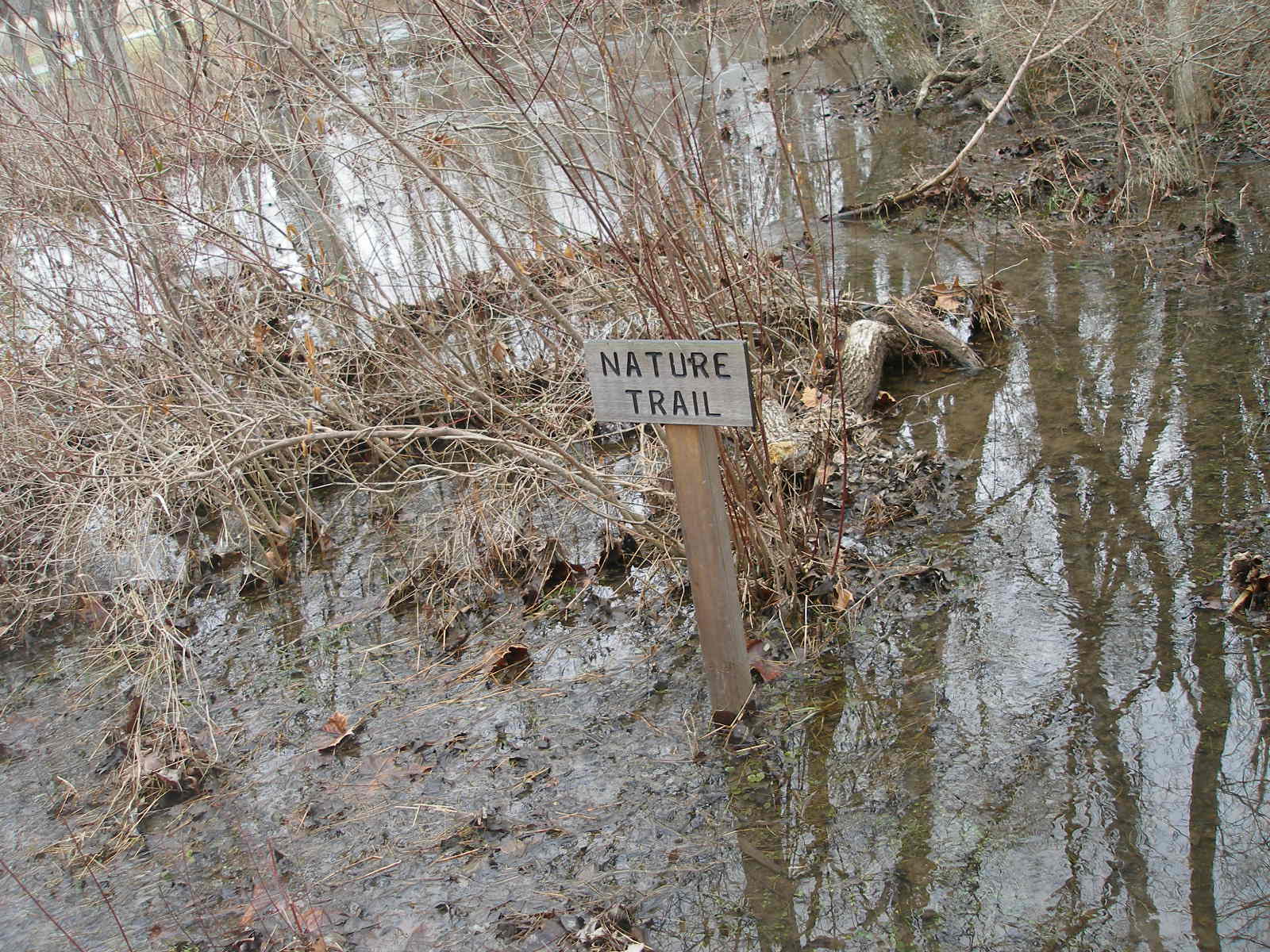
Below: This "nature trail" sign is oddly isolated out in the middle of a swamp area.


Just when I thought I was truly out in the middle of nowhere, I happened upon this deluxe and informative sign, telling me all about the importance of keeping Goose Creek clean:


And then there's this old plastic sign with what seems to be the international symbol for "no hikers allowed", but it was laying flat in the ground in a remote part of the woods. Which way had it been meant to indicate to keep out? Impossible to tell for sure. I kept walking, of course.


It sure does seem like there's a lot of plastic signs littering the landscape even as they warn me of the importance to protect the environment. Here's another, with the surreal title "Wetlands: Nature's Kidneys".

Friday, February 18, 2011

Where Dead Voices Gather


In addition to all the many deaths that took place behind closed doors at the multi-named Lakeland asylum - and there were many - I'm also intrigued by the ones that took place outside.

Some in-the-know folks have told me that many patients drowned trying to escape through an aquaduct that leads to the Lake for which Lakeland is named. I'm looking into that and will report soon. Another anecdote I've been told is that someone, presumably a patient, climbed the water tower on the asylum's grounds and committed suicide by jumping off. For some reason, this story has stuck in my head lately and I decided to try to figure out the exact spot where this occurred.

Fortunately, the photograph above gives us a near-precise indication of where the tower stood. Yesterday morning I trudged out there in search of the spot and found a semi-circular sunken area, partially paved, with a service road leading into it. This would seem to be it.


There were also other interesting and possibly related structures in the vicinity, like a large rusting pipelike opening that is filled with mud and leaves (image 1), an opening in the ground covered by a square stone slab (image 2), a huge hole in the ground that upon further inspection was revealed to be a partially exposed well of some sort (images 3 thru 6), a similar but above-ground enclosure that appears to have once been part of a sewer system (images 7 thru 10), and several other large holes that may lead somewhere or may just be really large fox holes (image 11).


And keeping with my anti-plastic environmental concerns from yesterday's post about all the antiquated garbage along the fenceline, I noticed some lackadaisical park groundkeepers apparently chose to ditch a pile of plastic plant containers in the nearby woods (image 12). Not cool.

It's been said that the asylum area is a great hotspot to get ghostly EVP recordings of the voices of the dead, especially near the cemetery. I remain lukewarm on the EVP concept, just as I have little reason to swallow most of the other gimmicks employed by so-called would-be "ghost hunters". Although I heard a tape a few years ago purportedly recorded here, sounding indeed like spirit voices, there was no chain of evidence for it. And I don't take anything on faith.

Mind you, that doesn't mean I necessarily disbelieve in ghosts and ghouls and things that go boomp in the night. I would hazard a guess that the asylum grounds are dense with gathered spirits, entities, life-force energy, or whatever you wish to call it. This would probably also include the unfortunate soul who jumped from the water tower and hopefully found some subsequent peace. But for those who seem to have an unhealthy obsession with "contacting the dead" and so forth, it's going to take more than a tape recorder, a gaussmeter, and some wishful thinking to establish communication with anything unseen.

(Do I have a better idea? I do indeed, and I'm working on it. Wait and see. All in time.)

Thursday, February 17, 2011

An Archaeologic Assay of Human Artifacts Deposited Alongside Roads, Vol. 1


On Lakeland Road in Anchorage, there's this deep gulch running alongside the E.P. Sawyer Park. The park, as my regular readers are probably tired of hearing about, used to be the grounds of the Central State Insane Asylum and is so haunted, they say you have to scrape the ectoplasm off your shoes when you get back to your car. (I exaggerate only slightly.)

Lakeland Road, incidentally, used to be a railroad track that shuttled directly to the asylum. If you look closely at some points you can still see evidence of the tracks before they paved it over and turned it into a road. And human beings, filthy creatures that they are, have been tossing crap out their car windows along that road ever since.

Today while in the park searching for the exact spot where the asylum's water tower had stood (more about that tomorrow), I happened up the embankment where the park's fenceline meets the aforementioned roadside gulch. It has acted as a catch-net for much of the debris that has been accruing there for decades, and while my left brain was appalled that no one has cleaned that area up for so long, my right brain was fascinated by inspecting what humanity had sloughed off.

Without even doing any digging or disturbing the site at all, I could visually identify corroding beer and soda cans from the 1970s with pull-tabs rather the modern stay-tabs. (Stay-tabs were introduced in 1975 and had become the industry standard in the United States by that decade's end.) Most of the outer layers of garbage were recognizably between the 1980s and the present. And if you think that's not very old, let me remind you that 1991 was two decades ago.

I spotted evidence of much older strata of trash peeking out here and there, however - large murky green and brown bottles, and a fragment of very old floor linoleum (seen in images #16 and #17). A little digging with a shovel would likely yield some more serious finds.


I found a liquor bottle still partially filled with what I presume is vodka or gin because it's clear and the lid is tightly sealed (see image #5). Then again, I also found a pop bottle full of a liquid bearing that unmistakable color of urine (see image #3). Such are the hazards of my profession.

What am I seeing in image #14? Is it a child's sweater? A hat? Definitely some sort of abandoned clothing. It appears to have a face on it. I didn't even really notice it until after I got home and looked at the pictures closely.

While the junk seen here isn't as immediately compelling as, say, the old dumpsite in Elliott County I chanced upon a few years ago, I betcha there's all kinds of groovy goodies lurking under the surface. Avid fan of urban archaelogy that I am, you can be sure this gulch hasn't seen the last of me.

Monday, October 11, 2010

Lakeland Asylum Markers


The bronze commemorative marker on the grounds of the now-demolished Central State Asylum at Lakeland (Anchorage) vanished awhile back, and no one seems to know what became of it.

Recently, while taking my early-morning coffee-walk constitutional in the E.P. Sawyer Park (which now occupies the haunted former asylum property), I discovered that not one but two new markers have appeared. One's your basic state historical marker, pretty vague and dry and not terribly informational in its capsule description. The other is a surprisingly elaborate presentation that speaks of the asylum's horrors with a little more candor, but still doesn't even begin to touch upon the full nauseating extent of the atrocities said to have occurred here in the name of psychiatry.


The photos were taken with a flash since it was 5:30am and pitch black dark out (I couldn't even read these plaques until I got home and looked at my own photos.) Don't mention the "orbs" in the photo unless you want to be thoroughly ridiculed.

Sunday, January 10, 2010

Freak Lightning Strikes Asylum


From the Times Picayune, New Orleans, July 3, 1901:

Louisville, Ky., July 2 - A bolt of lightning from a clear sky that struck among eighty inmates of the Central Kentucky Asylum for the Insane at Lakeland, eleven miles from Louisville, at 3:30 this afternoon, killed JAMES HOWARD, aged 38, of Stevensport, Ky., and knocked unconscious Nat Mercer, an attendant, and three other patients.

Great excitement followed among the insane persons who had been taken into the yard for air, but rain came and drove them back to their quarters. The attendant and the patients who were knocked senseless will recover.

Friday, October 30, 2009

Central State Asylum Blog


Our pal Jay Gravatte of the Louisville Ghost Hunters emailed me last night with exciting news: he's got a brand-new blog devoted to one of my favorite Kentucky haunt-spots: the Central State Asylum.

Check out his blog at http://centralstatehospital.blogspot.com/

Friday, December 12, 2008

Willow Lake Tavern


Willow Lake Tavern has existed for decaded near the corner of Lakeland and LaGrange in Anchorage, is on property formerly near the Central State Asylum's 19th century grounds, and not surprisingly, has been the source of many hauntings, sightings, and ethereal disturbances.

I dropped into the place last summer while researching the Weird Kentucky book. I tossed back a few brews and grilled the locals about whether they'd seen anything spooky around the joint. One patron of the bar, without my prompting, even went so far as to compare it to Bobby Mackey's, and noted: "I never believed in ghosts until I moved to Kentucky".

In its early years, the asylum operated a trolley car on its own private railroad tracks that existed where Lakeland Road sits today (you can still see the paved-over railroad ties peeking out from under the asphalt in some places). The Willow Lake Tavern's location back then was on the border of the Huston and Whipps farms. This is quite near where the "switching yard" would have been, for transferring the patients being shuttled in on their bleak journey from the incoming train car on the main tracks.

Recently the Willow Lake Tavern has become Selena's Restaurant but thankfully, the new owners have left the old neon sign intact. The mood there is considerably more upscale and the food is great, check 'em out!

Central State Hospital Cemetery


A huge area of Anchorage, KY, including all of the vast E.P. Sawyer Park, was once the dreaded Central State Mental Hospital and its sprawling grounds.

In 1873 the place was the Lakeland Home for Juvenile Delinquents, which soon thereafter expanded its purpose to become an insane asylum. No asylum of that era was ever a friendly place to be, but this one takes the proverbial cake. For decades, hellish conditions, improper care, senseless deaths and unchecked madness lent a continually greasy patina of very bad karma to this land.

Think of every horror story you’ve ever heard about psychiatry, and it’s all here: overcrowding, abuse, insulin “therapy,” forced freezing cold showers as “treatment,” crude lobotomies, electroshocks, you name it. According to Jay Gravatte of the Louisville Ghost Hunters, wards with a capacity for 1600 persons were containing more like 2400, and in 1943 the Kentucky grand jury discovered that Central State was unfairly committing and imprisoning people who were not mentally ill.

Today all the original buildings are demolished, and a new complex of modern clean edifices stand down the road, at the corner of Lakeland and LaGrange. The old asylum's site can be seen here on Google Maps, and if you scroll just a bit south, you'll see the present facilities.


Voices, purportedly of the dead, have been tape-recorded late at night by ghost hunters in the hospital's long-abandoned cemetery, which is also now part of the E.P. Sawyer park grounds. Most of the stones are now missing, and the ones that are still extant are misplaced and piled haphazardly around nearby trees. You can still tell where the graves are, however, by the prominent sinkholes that dot the landscape. It’s one of the most neglected and poorly maintained cemeteries I’ve ever seen, and these people interred here were unhappy enough from the getgo without having their final resting place so shoddily treated.

I have heard the tape and, for what it’s worth, voices are clearly heard although I can’t make out any of it. I remain dubious about the whole EVP concept.